CPA vs Crypto Tax Software in UK (2026): Which Is Best for HMRC Compliance?

Table of Contents

CPA vs Crypto Tax Software in UK (2026 Guide): Which One Is Better?

CPA vs crypto tax software in UK is one of the most important decisions crypto investors face in 2026.

Let’s be practical—UK crypto taxes are no longer simple. Once you start trading across multiple exchanges, using DeFi protocols, or investing in NFTs, your tax situation becomes complex very quickly.

That’s when investors face a critical decision:

 Should you hire a professional accountant (CPA), or rely on crypto tax software?

Both options help you stay compliant with HM Revenue and Customs rules—but they work in very different ways.

In this guide, we’ll break down real differences, costs, accuracy, and which option actually fits your situation in 2026.

What Is CPA vs Crypto Tax Software in UK? 

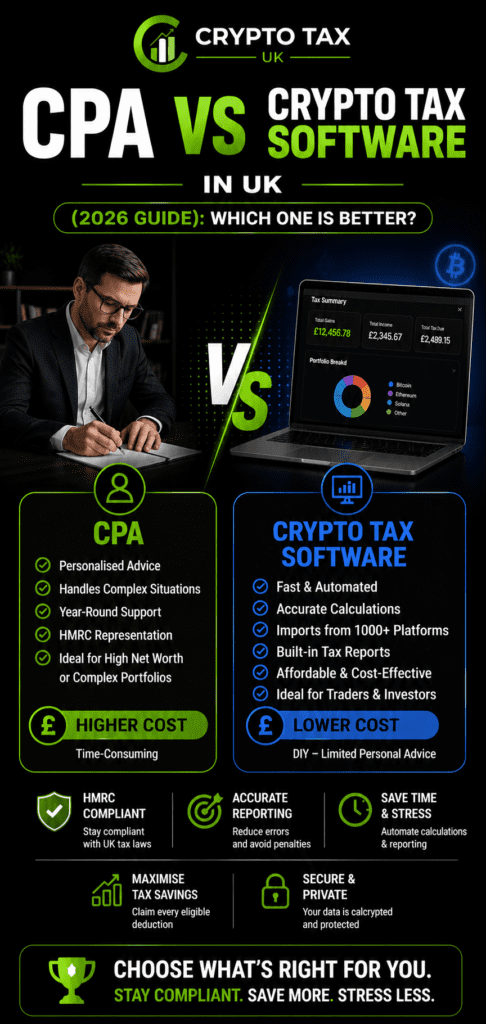
CPA vs crypto tax software in UK is a comparison between hiring a professional crypto accountant and using automated software tools to calculate, manage, and report cryptocurrency taxes in compliance with HM Revenue and Customs regulations.

 In simple terms:
CPA = human expertise
Crypto tax software = automated calculation system

CPA vs Crypto Tax Software in UK: Quick Comparison

FeatureCPA (Accountant)Crypto Tax Software
Cost£300 – £3,000+£40 – £300/year
AccuracyVery high (manual review)High (automation-based)
SpeedSlow (days/weeks)Fast (minutes)
DeFi/NFT HandlingExpert-levelTool-dependent
HMRC ComplianceFully managedSoftware-generated
SupportPersonal adviceLimited support

 This comparison shows the real trade-off: expert control vs automation speed

What Does a CPA Do in Crypto Tax?

A crypto CPA (accountant) manually manages your entire tax process.

Key services:

  • Full tax calculation
  • Transaction review and correction
  • Cost basis adjustments
  • Self Assessment filing
  • HMRC audit support

 CPAs are especially useful for complex cases like:

  • DeFi yield farming
  • NFT royalties
  • Business crypto income

What Does Crypto Tax Software Do?

Crypto tax software automates most of the process.

Popular tools include:

  • Koinly
  • Recap
  • CoinTracker

Key functions:

  • Import transactions automatically
  • Classify trades (buy/sell/swap/staking)
  • Apply UK rules (Section 104 pooling)
  • Generate HMRC-ready reports

 Software removes 80–90% of manual work

CPA vs Crypto Tax Software in UK: Key Differences

1. Accuracy

  • CPA → Human-reviewed, highly reliable
  • Software → Accurate but depends on data quality

 Real insight: software can misclassify DeFi transactions if not reviewed.

2. Cost

  • CPA → Expensive but strategic
  • Software → Affordable subscription

 Most retail investors prefer software due to cost efficiency.

3. Speed

  • CPA → Slow (manual work required)
  • Software → Instant reporting

 Software wins for deadline pressure.

4. Complexity Handling

  • CPA → Best for advanced portfolios
  • Software → Good but not perfect for complex DeFi

Hidden Insight: Why Most Investors Actually Need Both

Here’s something most blogs don’t mention:

 The smartest investors combine both CPA and software.

Real strategy:

  1. Use software to generate reports
  2. Use CPA to review and optimize

 Result:

  • Lower tax risk
  • Higher accuracy
  • Better compliance

Hidden Insight: Software vs CPA Can Change Your Tax Bill

Most investors assume both give the same result—but they don’t.

Different methods include:

  • FIFO (First In First Out)
  • Average cost method
  • Specific identification (CPA strategy)

 Result:
Same transactions → different tax outcome

When to Use Crypto Tax Software

Best if you:

  • Have under 1,000 transactions
  • Mainly use exchanges
  • Have limited DeFi activity
  • Want low-cost automation

 Ideal for most beginners and casual investors

When to Hire a CPA

CPA is better if you:

  • Have 1,000+ transactions
  • Use DeFi heavily
  • Trade NFTs regularly
  • Run a crypto business
  • Need audit protection

 CPA becomes essential in high-complexity cases

Real Example: CPA vs Software

Scenario:

  • 2,500 transactions
  • DeFi + NFT trading

Software only:

  • Fast report
  • Possible misclassification

CPA:

  • Accurate review
  • Tax optimization
  • Higher cost

 Best approach = software + CPA review

Common Mistakes to Avoid

  • Relying only on software without checking reports
  • Hiring CPA without clean data
  • Ignoring DeFi complexity
  • Choosing cheapest option instead of correct one

 These mistakes often lead to:

  • Overpaid tax
  • HMRC issues
  • Incorrect filings

HMRC Compliance Reminder

According to HM Revenue and Customs:

You must report:

  • Capital gains
  • Crypto income (staking, mining, airdrops)
  • All disposals

 Whether you use CPA or software, accuracy is your responsibility.

Pro Strategy: Reduce Tax Legally

Smart UK investors:

  • Use software for tracking
  • Offset gains with losses
  • Apply annual CGT allowance
  • Use CPA for final review

This is the most tax-efficient approach

FAQs

Is crypto tax software enough in the UK?

Yes, for simple portfolios. Complex cases may require CPA support.

Is a CPA worth it?

Yes, for high-volume or DeFi-heavy investors.

Can software replace a CPA?

Not fully. Software automates, CPAs optimize.

Which is cheaper?

Crypto tax software is significantly cheaper.

Latest Articles

Stay Connected

Inquiry Form
CPA vs Crypto Tax Software in UK (2026): Which Is Best for HMRC Compliance?

7 Crypto Tax Accountants: Expert Crypto Accounting & Tax Filing Services

Need reliable crypto accounting and tax filing services? Contact 7 Crypto Tax Accountants today by call or email to get expert support.

Conclusion

CPA vs crypto tax software in UK is not about which is better overall—it’s about what fits your situation.

Final verdict:

  • Simple portfolio → software is enough
  • Complex portfolio → CPA is required
  • Best strategy → combine both

 The smartest investors don’t choose one—they use both strategically.

DISCLAIMER

The information presented in this blog is sourced from publicly available and third-party materials. 7 Crypto Tax Accountants does not claim ownership of this content and provides it for general informational purposes only.

7 Crypto Tax Accountants makes no representations or warranties regarding the accuracy, completeness, or reliability of the information. You should not treat this content as financial, legal, or tax advice.

7 Crypto Tax Accountants is not responsible for any decisions, losses, or damages resulting from the use of this information. Until You  consult with 7 Crypto Tax Accountants before taking any action related to crypto taxation or financial matters.