Table of Contents
Staking vs Mining Tax Comparison in UK (2026 Guide)
staking vs mining tax comparison UK is one of the most misunderstood areas of cryptocurrency taxation in the United Kingdom in 2026.
In most cases, investors assume staking and mining are taxed in the same way or that tax only applies when crypto is sold. These assumptions are incorrect under HM Revenue and Customs rules.
In reality, both staking and mining are taxable, but they differ in classification, timing, and allowable deductions. Understanding these differences is essential to avoid penalties, underreporting, or incorrect Self Assessment filings.
This guide explains staking vs mining taxation in the UK with real examples, official rules, and practical compliance insights.
What is Staking vs Mining Tax Comparison UK?
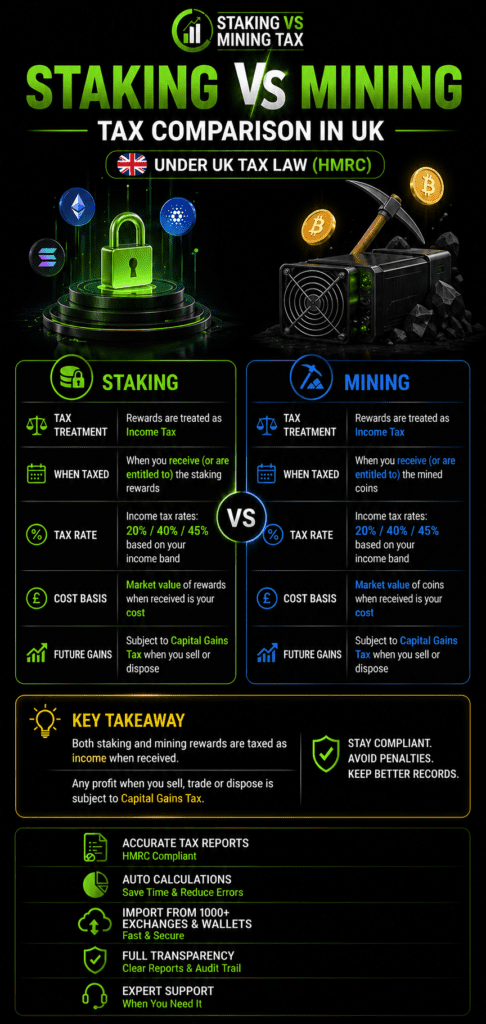
staking vs mining tax comparison UK refers to the difference in how cryptocurrency staking rewards and mining rewards are taxed under HM Revenue and Customs rules. Both are generally treated as taxable income at the point of receipt, with additional Capital Gains Tax potentially applied when the assets are later disposed of.
In simple terms:
- Staking = earning rewards by locking crypto
- Mining = earning new coins through computational work
Both generate taxable income, but their cost treatment and reporting complexity differ.
Why Staking and Mining Are Taxed in the UK
Crypto taxation in the UK is based on the principle that any value received in exchange for services, validation, or reward is taxable.
Under HM Revenue and Customs guidance:
- Crypto received from staking is treated as income
- Crypto mined through computational work is treated as income
- Disposal of crypto later triggers Capital Gains Tax
This creates a two-stage tax structure:
- Income Tax at receipt
- Capital Gains Tax at disposal
Quick Staking vs Mining Tax Comparison (UK 2026)Feature Staking Mining Tax Type Income Tax Income Tax Tax Authority View Passive reward income Active income / business activity Tax Timing At receipt At mining reward receipt Capital Gains Tax On disposal On disposal Expense Deductions Limited Significant (electricity, hardware) Complexity Medium High
| Feature | Staking | Mining |
|---|---|---|
| Tax Type | Income Tax | Income Tax |
| Tax Authority View | Passive reward income | Active income / business activity |
| Tax Timing | At receipt | At mining reward receipt |
| Capital Gains Tax | On disposal | On disposal |
| Expense Deductions | Limited | Significant (electricity, hardware) |
| Complexity | Medium | High |
How Staking is Taxed in the UK
Staking rewards are treated as taxable income at the point of receipt under HM Revenue and Customs rules.
Tax treatment:
- Taxed based on GBP market value at the time received
- Declared as income on Self Assessment
- Subject to Income Tax
Example:
- Staking reward: 1 ETH
- Value at receipt: £2,000
You must report £2,000 as taxable income.
Later:
- If sold for £2,500
- Capital Gain = £500
This creates a dual taxation structure.
How Mining is Taxed in the UK
Mining is also treated as taxable income under HM Revenue and Customs rules, but is more complex due to its business-like nature.
Tax treatment:
- Mining rewards are taxed as income at receipt
- GBP value is calculated at time of mining
- Later sale triggers Capital Gains Tax
Additional feature:
Mining may allow expense deductions such as:
- Electricity costs
- Mining equipment
- Maintenance and hosting fees
Example:
- Mining reward: 0.5 BTC
- Value at receipt: £15,000
You must report £15,000 as income.
Later:
- Sold for £18,000
- Capital gain = £3,000
Key Differences Between Staking and Mining Tax UK1. Nature of activity
- Staking: Passive income from holding crypto
- Mining: Active production requiring computational resources
2. Expense treatment
- Staking: Limited deductible expenses
- Mining: Significant allowable business expenses
3. Complexity level
- Staking: Easier to report
- Mining: Requires detailed cost tracking
Hidden Insight: Why Both Can Be Taxed Twice
A critical but often misunderstood rule under HM Revenue and Customs is that both staking and mining may be taxed in two stages:
- Income Tax when rewards are received
- Capital Gains Tax when assets are sold
This structure significantly increases compliance complexity and is a common source of reporting errors among UK investors.
Common Mistakes Investors Make1. Not reporting staking rewards
Many investors incorrectly assume staking rewards are not taxable until converted to fiat.
2. Ignoring mining income
Even small mining rewards must be declared.
3. Incorrect valuation
HMRC requires GBP valuation at the exact time of receipt.
4. Missing capital gains reporting
Selling rewards without CGT calculation leads to underreporting.
5. No expense tracking for mining
Mining deductions are often missed, resulting in overpaid tax.
Which is More Tax Efficient?Staking advantages:
- Simpler reporting
- Lower operational complexity
- Suitable for passive investors
Mining advantages:
- Allows expense deductions
- Can reduce taxable income
- More flexible for business use
Conclusion:
Mining offers more tax optimization opportunities, but staking is easier and less compliance-heavy.
HMRC Compliance Requirements
Under HM Revenue and Customs rules, UK taxpayers must report:
- Staking income
- Mining income
- Capital gains on disposal
- Full transaction history where applicable
Failure to comply may result in:
- Financial penalties
- Interest on unpaid tax
- Compliance investigations
Pro Strategy: Legal Tax Optimization
Experienced UK investors reduce tax liability by:
- Tracking staking rewards in real time
- Deducting mining-related expenses
- Using annual Capital Gains Tax allowance
- Reconciling transactions using crypto tax software
- Reviewing reports before submission
FAQsIs staking taxable in the UK?
Yes, staking rewards are taxable as income at the time of receipt.
Is mining taxable in the UK?
Yes, mining income is taxable under HMRC rules.
Do I pay tax twice on staking or mining?
Yes, income tax on receipt and capital gains tax on disposal.
Which is more complex, staking or mining?
Mining is more complex due to expense tracking and valuation rules.
Does HMRC track staking and mining?
Yes, HM Revenue and Customs uses exchange data and blockchain analytics for compliance monitoring.
Latest Articles
Stay Connected
7 Crypto Tax Accountants: Expert Crypto Accounting & Tax Filing Services
Need reliable crypto accounting and tax filing services? Contact 7 Crypto Tax Accountants today by call or email to get expert support.
Conclusion
staking vs mining tax comparison UK shows that both activities are fully taxable under HM Revenue and Customs rules, but differ in structure and complexity.
Key takeaways:
- Both are taxed as income at receipt
- Both trigger Capital Gains Tax on disposal
- Mining allows more expense deductions
- Staking is simpler but less flexible
The real risk is not staking or mining itself, but incorrect reporting under UK tax law.
DISCLAIMER
The information presented in this blog is sourced from publicly available and third-party materials. 7 Crypto Tax Accountants does not claim ownership of this content and provides it for general informational purposes only.
7 Crypto Tax Accountants makes no representations or warranties regarding the accuracy, completeness, or reliability of the information. You should not treat this content as financial, legal, or tax advice.
7 Crypto Tax Accountants is not responsible for any decisions, losses, or damages resulting from the use of this information. Until You consult with 7 Crypto Tax Accountants before taking any action related to crypto taxation or financial matters.