Table of Contents
DeFi Accounting UK (2026 Guide): Full HMRC Rules Explained
Decentralized finance (DeFi) is transforming how people earn, lend, and trade digital assets. But with this innovation comes a major challenge—tax reporting and accounting.
DeFi accounting UK has become a critical topic for investors, businesses, and accountants dealing with blockchain-based income streams.
In the UK, DeFi transactions are monitored under guidelines from HM Revenue and Customs, which means every swap, reward, or yield event may have tax consequences.
This guide explains everything you need to know about DeFi accounting UK, including tax rules, reporting methods, and compliance strategies.
What Is DeFi Accounting in the UK?
DeFi accounting UK refers to the process of tracking, recording, and reporting decentralized finance transactions for tax and financial purposes.
DeFi activities include:
- Yield farming
- Liquidity provision
- Staking rewards
- Lending and borrowing
- Token swaps on decentralized exchanges
Each of these actions can trigger taxable events depending on how they are structured.
How HMRC Treats DeFi Transactions
According to HM Revenue and Customs, DeFi is not treated as a separate tax category. Instead, it is taxed based on underlying activity.
Common classifications include:
- Capital Gains Tax (CGT): when disposing of crypto assets
- Income Tax: when earning rewards or interest
- Trading Income: for active DeFi businesses
This classification is the foundation of DeFi accounting UK rules.
Key DeFi Taxable Events in the UK
Understanding taxable events is essential for accurate DeFi accounting UK:
1. Token Swaps
Swapping one crypto asset for another is treated as a disposal event.
2. Liquidity Provision
Earning fees from liquidity pools may be taxable income.
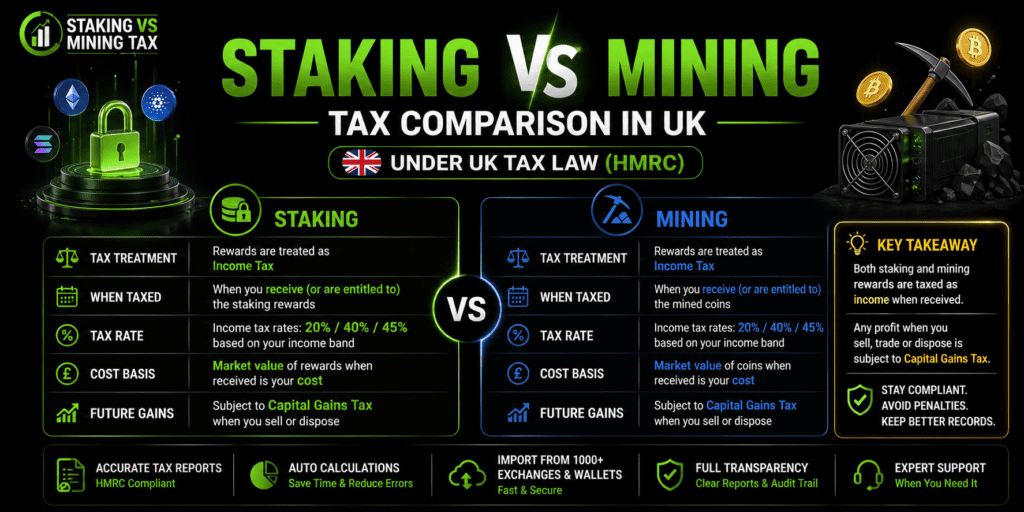
3. Staking Rewards
Rewards are often treated as income at fair market value.
4. Yield Farming
Returns generated from DeFi protocols are usually taxable.
5. Borrowing and Lending
Interest earned or fees may also be taxable.
Capital Gains Tax in DeFi Accounting UK
When crypto assets are disposed of in DeFi transactions:
- You calculate gain = disposal value – cost basis
- Each swap or trade may trigger CGT
- Annual CGT allowance may apply
This makes tracking essential in DeFi accounting UK.
Income Tax in DeFi Activities
Some DeFi earnings are treated as income rather than capital gains.
Examples:
- Staking rewards
- Yield farming profits
- Interest from lending platforms
These are taxed at your standard income tax rate under UK law.
Challenges in DeFi Accounting UK
DeFi creates unique accounting challenges:
1. High Transaction Volume
Hundreds of micro-transactions make tracking difficult.
2. Lack of Centralized Records
No single authority provides complete statements.
3. Token Price Fluctuations
Valuation must be recorded at transaction time.
4. Cross-Platform Activity
Users often interact with multiple DeFi protocols.
These challenges make DeFi accounting UK more complex than traditional crypto accounting.
Best Practices for DeFi Accounting UK
To stay compliant with HMRC:
Use Crypto Accounting Software
Automate tracking of wallets and transactions.
Record Every Transaction
Include swaps, fees, and rewards.
Convert Values to GBP
All transactions must be reported in GBP.
Separate Wallets
Keep personal and business DeFi activities separate.
Work with Crypto Tax Experts
Professional advice reduces compliance risks.
DeFi Accounting for Businesses in the UK
For companies, DeFi accounting UK involves additional responsibilities:
- Corporation Tax reporting
- VAT considerations (in limited cases)
- Financial statements preparation
- Audit readiness
Businesses using DeFi must maintain strict financial records to comply with UK regulations.
Role of HMRC in DeFi Regulation
The HM Revenue and Customs ensures:
- Accurate reporting of crypto income
- Enforcement of capital gains tax rules
- Monitoring of digital asset activity
- Prevention of tax evasion
As DeFi grows, HMRC is expected to introduce more detailed reporting standards.
Future of DeFi Accounting UK (2026 & Beyond)
The future of DeFi accounting UK will likely include:
- Automated blockchain tax reporting systems
- Stricter HMRC compliance rules
- AI-powered transaction tracking tools
- Integration with DeFi protocols for real-time tax data
Regulation will continue evolving as DeFi adoption increases.
FAQsWhat is DeFi accounting in the UK?
It is the process of tracking and reporting DeFi transactions for tax purposes.
Is DeFi taxable in the UK?
Yes, DeFi income and gains are subject to tax under HMRC rules.
Do I pay tax on DeFi staking rewards?
Yes, staking rewards are usually treated as income.
Who regulates DeFi tax in the UK?
HM Revenue and Customs (HMRC).
Do I need software for DeFi accounting?
Yes, due to complex transactions, software is highly recommended
Latest Articles
Stay Connected
7 Crypto Tax Accountants: Expert Crypto Accounting & Tax Filing Services
Need reliable crypto accounting and tax filing services? Contact 7 Crypto Tax Accountants today by call or email to get expert support.
Conclusion
DeFi accounting UK is one of the most complex areas of crypto taxation due to high transaction volume and decentralized systems.
However, with proper tracking, compliance tools, and understanding of HMRC rules, investors and businesses can manage their DeFi taxes effectively.
As the DeFi ecosystem grows, accurate accounting will become even more important for financial success and regulatory compliance.
DISCLAIMER
The information presented in this blog is sourced from publicly available and third-party materials. 7 Crypto Tax Accountants does not claim ownership of this content and provides it for general informational purposes only.
7 Crypto Tax Accountants makes no representations or warranties regarding the accuracy, completeness, or reliability of the information. You should not treat this content as financial, legal, or tax advice.
7 Crypto Tax Accountants is not responsible for any decisions, losses, or damages resulting from the use of this information. Until You consult with 7 Crypto Tax Accountants before taking any action related to crypto taxation or financial matters.